Estonia’s greatest modernist painter receives first UK exhibition
Dulwich Picture Gallery will present the first major UK exhibition of Konrad Mägi (1878–1925) in partnership with the Art Museum of Estonia, from 24 March 2026 – 12 July 2026. A pioneer of Estonian modernism, Mägi is renowned in his home country for his avantgarde, unique colouristic style and is widely considered the greatest Estonian artist of his generation.
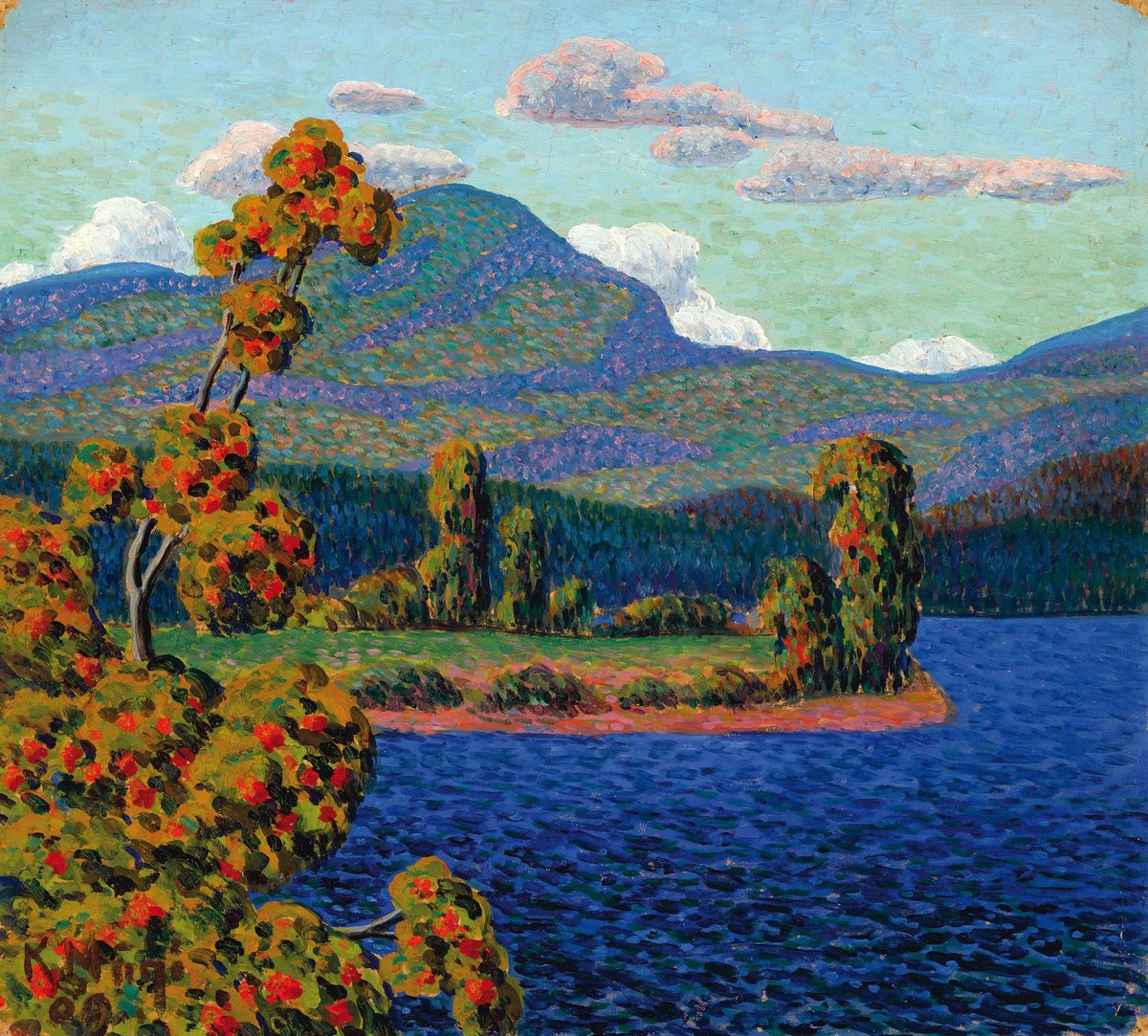
The exhibition will bring together over 60 works, including enigmatic landscapes and arresting portraits, many of which have never been seen outside of Estonia. It will consider the influence of major European movements upon Mägi’s work, such as Pointillism, Neo-Impressionism and Expressionism, as well as the independent approaches that he took in painting as a largely self-taught artist.
Mägi decided to study at the Stieglitz Art School in St. Petersburg in 1902, during this time he encountered numerous exhibitions, museums and visual art. Following the pivotal period after the Revolution in 1905, many Estonian intellectuals travelled abroad to experience other cultures, a trend inspired by the founding of the Noor-Eesti movement (Young Estonia) and their motto ‘Let us remain Estonians, but let us also become Europeans’. Mägi travelled extensively throughout his life to Norway, France, Italy, Belgium and Finland, and his exposure to European art and ideals had a profound impact upon his paintings.
Throughout his career, Mägi’s work evolved significantly, marked by bold experimentation with brushstrokes, colour, motifs, and perspective. After spending time in Norway between 1908 and 1910, he created a series of Norwegian landscapes that brought him his first artistic recognition. The works from this period reveal his profound connection to the natural world, painted during a challenging chapter in his life.
His portraits, mostly commissioned by wealthy Estonian families, showcase his distinctive use of colour, combined with arresting facial expressions that place his subjects at the centre of the work. Historically overshadowed by his landscapes, this exhibition brings Mägi’s portraiture to the fore, tracing the evolution of his style with artistic influences from Cubism to German Expressionism.
Turning to the Baltic islands following his declining health, Mägi produced a significant body of work during the summers of 1913 and 1914. The exhibition will showcase paintings created in Saaremaa and Vilsandi, representing a breakthrough moment artistically for the artist. These works demonstrate his fascination with the unique botanical species of the landscape including flora, fauna, and the vastness of the sea.
Mägi’s landscapes of Southern Estonia, created in the latter period of his life, will be presented in the final room of the exhibition. These paintings demonstrate the artist’s fascination with capturing the rhythm and tone of the natural landscape; the idyllic lakes of the area become the protagonists of his paintings and often feature dramatic skies that express inner emotions. Interested in the mystical and sublime, Mägi was known to have read works by writers and philosophers such as Edgar Allen Poe, Paul Verlain, Friedrich Nietzsche.
A new installation by Kristina Õllek
Within the exhibition, contemporary Estonian artist Kristina Õllek will create an installation in the Gallery’s mausoleum as a newly commissioned site-specific work.
Presented in the context of Mägi’s paintings, the installation draws on her long-term research into Baltic Sea ecology. Using sea salt, cyanobacteria and limestone, she reflects on the Baltic Sea’s current state and its dead zones, while also evoking the deep time of ancient marine life in the coastal landscape of Estonia. This is especially visible in the Silurian limestone of Saaremaa, an island that also played an important role in Mägi’s work.
Õllek’s own practice is deeply engaged with the idea of investigating processes, geological matter, aquatic ecology, and human-made environments. Her installations raise questions about the values and meaning surrounding marine life and the impacts of humanity.
Describing her work and the influence of Konrad Mägi upon her practice, Õllek said: “Showing my work alongside Konrad Mägi is a genuinely unique experience. I look forward to seeing how our works begin to speak to one another, and how our differing perspectives and timelines shape our understanding of the environment.”
Uniting distinctive works from Mägi’s career, the exhibition will introduce an artist with an enduring impact. It will showcase how Mägi was continuously in cultural dialogue with European art and ideas, yet remained rooted in the landscapes of his homeland as he translated inner emotions into expressive works.
The exhibition is curated by Kathleen Soriano, Director of Hastings Contemporary and celebrated broadcaster and judge on Sky Arts, Portrait Artist of the Year. Soriano curated the Gallery’s popular exhibitions M.K. Čiurlionis: Between Worlds, 2022; and Harold Sohlberg: Painting Norway, 2019.
Kathleen Soriano, Curator, said: “Sometimes it is the unfamiliar that gives us pause for thought and that allows us to understand more clearly the interconnectedness of creativity across the world. To be able to consider Mägi in a broader art historical context, and for the first time in a concerted manner in the UK, shows us that there are many more artists out there deserving of attention.”
Sirje Helme, Chief Executive Officer of the Art Museum of Estonia Foundation, said: “The exhibition of works by Estonia’s most famous modernist painter, Konrad Mägi (1878–1925), at Dulwich Picture Gallery is a very important event for the Art Museum of Estonia, and I am very grateful to the Gallery for this. It is an opportunity to introduce Estonian culture as part of the development of European modernism, emphasising the artist’s uniqueness in depicting the colours and light of nature. The connection with nature is important to us and is also expressed in the work of Kristina Õllek.”
Jennifer Scott, Director of Dulwich Picture Gallery, said: “Mägi’s mastery of colour transports us to a place of vibrancy and emotional depth. It is an honour to have these paintings on special loan from Estonia and to introduce UK audiences to Mägi’s unique and captivating vision.”
-ENDS-
Notes to editors
For further information or images please contact:
Eibhlín Kissack, PR Manager | [email protected]
Images
Publicity images can be downloaded from the press pack.
Image Credits
Konrad Mägi, Norwegian Landscape, 1909. Courtesy of the Art Museum of Estonia.
Konrad Mägi, Portrait of a Lady (Klaara Holst), 1916. Courtesy of the Art Museum of Estonia.
Listings Info
Konrad Mägi
24 March 2026 – 12 July 2026
Tickets
The ticket on sale date will be announced via Dulwich Picture Gallery’s website and social media channels a few months prior to the exhibition opening.
Dulwich Picture Gallery
The Original Gallery. Est. 1811.
It started here with a simple idea – that great art is made for sharing. Which is why, over 200 years ago, Dulwich Picture Gallery opened its doors and became the world’s first purpose built public art gallery – a sanctuary in the city, dedicated to sharing one of the greatest art collections in the world, with the world. We remain dedicated to our mission of unlocking art for all. From historic paintings to contemporary sculpture, we’re committed to bringing art to life and life to art. Finding new and surprising ways for people to enjoy, appreciate, and be inspired by great art – inside and out.
The Gallery is known for its programme of revelatory exhibitions, which present artists that are largely unknown or overlooked in the UK. In recent years, the Gallery has introduced the work of Scandinavian and Baltic artists, renowned in their home countries, to audiences in UK-first major exhibitions, including Tove Jansson, M. K. Čiurlionis, Harald Sohlberg and Anna Ancher.
Kristina Õllek
Kristina Õllek
Kristina Õllek (b. 1989, Tallinn, Estonia) is a visual artist based in Tallinn, Estonia.
She works in the fields of photography, video and installation, often making use of microbial and chemical processes, with a focus on investigating aquatic ecosystems, geological matter and human-altered environments. Kristina Õllek holds a Bachelor’s degree (2013) and a Master’s degree (2016) from the Photography Department of the Estonian Academy of Arts. She furthered her studies at Kunsthochschule Berlin-Weissensee in 2012 and at the Piet Zwart Institute in Rotterdam in 2016. Õllek was awarded the Estonian Academy of Arts Young Artist Prize in both 2013 and 2016.
From 2013 to 2018, she was a co-founder and active member of the artist-run space Rundum. In 2023, she received a three-year artist grant from the Estonian Artists’ Association and the Estonian Ministry of Culture. Her work has been exhibited in numerous international solo and group exhibitions, including at Kai Art Center (Tallinn), Kumu Art Museum (Tallinn), the Contemporary Art Museum of Estonia (Tallinn), M. K. Čiurlionis National Museum of Art (Kaunas), Henie Onstad Kunstsenter (Oslo), State of Concept (Athens), La Traverse (Marseille), Zeppelin Museum (Friedrichshafen), A Tale of A Tub (Rotterdam), Le Lieu Unique (Nantes), Screen City Biennial (Stavanger) and Fotomuseum Winterthur. Her new commissioned work is part of the current group show For All Last Return at Baltic Centre for Contemporary Art (Gateshead) and recently she participated at Minor Attractions 2025 (London).
Exhibition Supporters
Presented in partnership with the Art Museum of Estonia and the Embassy of Estonia.
With thanks to major supporters Konrad Mägi Foundation and NG Investeeringud.